Suzuki Fronx scores one star in ANCAP due to rear seatbelt failure
The Suzuki Fronx has received a one-star safety rating from the Australasian New Car Assessment Program (ANCAP) following its most recent crash test evaluation. The result stands in contrast to the Fronx’s performance in other global assessments, where it achieved higher ratings under Japan NCAP and ASEAN NCAP protocols earlier this year.
ANCAP’s assessment revealed that the Fronx scored below the 50 percent threshold in both adult and child occupant protection categories. While certain active safety features and road user protection systems delivered comparatively stronger results, shortcomings in occupant restraint performance significantly affected the overall rating.
Adult Occupant Protection
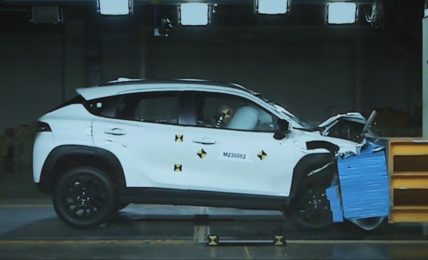
In adult occupant protection, the Fronx scored 19.30 out of 40 points, translating to 48 percent. During frontal offset crash testing, protection levels for front-seat occupants were rated between weak and marginal, although head and pelvis protection were assessed as good.
More concerning was the outcome of the full-width frontal impact test, where the rear seatbelt reportedly unlatched during the crash simulation. According to ANCAP, this resulted in the rear occupant not being adequately restrained, leading to poor head and chest protection and a zero score for rear adult occupant performance in this test. Side impact and oblique pole tests showed marginal to good protection levels, though far-side impact testing was not conducted due to the absence of a centre airbag.
ANCAP described the seatbelt issue as both rare and serious, advising that rear seats should not be used until the cause is identified and corrective measures are implemented.
Child Occupant Protection
The Fronx recorded 20.06 out of 49 points (40 percent) for child occupant protection. ANCAP noted that the absence of rear seatbelt pretensioners compromised occupant restraint during impacts. In frontal crash tests, head protection for both six- and ten-year-old child dummies was rated poor, while chest protection ranged from marginal to weak.
Side impact testing delivered better chest protection results, but head protection for the six-year-old dummy was downgraded after contact with the adjacent child restraint system.
Road User Protection
Road user protection emerged as one of the Fronx’s stronger areas, with a score of 41.39 out of 63 points, or 65 percent. ANCAP observed that the bonnet and windscreen offered good to adequate pedestrian head protection in most areas, though performance dropped near the A-pillars. Pelvis and upper leg protection was rated poor, while lower leg protection was assessed as good.
The vehicle’s autonomous emergency braking system demonstrated adequate performance in scenarios involving pedestrians, cyclists and motorcyclists. However, ANCAP noted that the system did not respond to potential hazards approaching from behind the vehicle.
Safety Assist Systems
In the safety assist category, the Fronx scored 10.03 out of 18 points (55 percent). The car’s autonomous braking system performed well in frontal and intersection collision scenarios but lacked head-on collision detection. Lane-keeping assistance was found to function effectively, and seatbelt reminders were available for all seating positions, though the rear centre seat did not feature occupant detection.