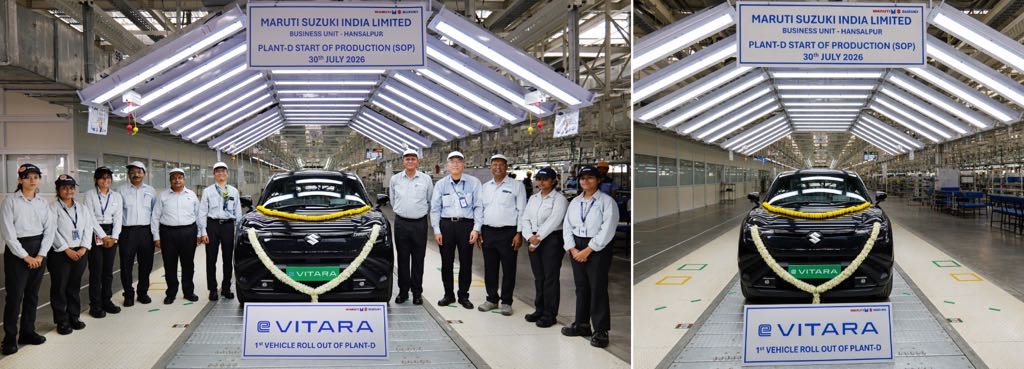
Maruti Suzuki has expanded its manufacturing operations at Hansalpur in Gujarat with the commencement of production at a fourth plant within the facility. The addition takes the site’s annual production capacity to 10 lakh vehicles, making it Suzuki’s first manufacturing location globally to reach the one-million-unit mark.
The new Plant D adds 2.5 lakh units of annual capacity to Hansalpur, which could previously manufacture 7.5 lakh vehicles per year. According to Maruti Suzuki, the expansion also makes Hansalpur the largest passenger vehicle manufacturing facility at a single location in India by installed capacity.
Production at Plant D has commenced with the e Vitara, Maruti Suzuki’s first battery electric vehicle. The company has invested Rs. 3900 crores in the new plant, while its cumulative investment at the Hansalpur manufacturing complex now stands at Rs. 25,288.7 crores.
Spread across approximately 640 acres, Hansalpur is already an important manufacturing and export base for Maruti Suzuki. The facility produces models including the Baleno, Swift and Fronx in addition to the newly introduced e Vitara.
The Gujarat facility has also developed into a major export hub for the company. During FY2025-26, vehicles produced at Hansalpur accounted for nearly 47 percent of Maruti Suzuki’s total exports, underlining the site’s importance beyond the domestic market.
Hansalpur’s production capacity has been expanded in phases since operations began. Plant A commenced production in 2017, followed by Plant B in 2019 and Plant C in 2021. The commissioning of Plant D in 2026 has now taken the site’s total capacity to 10 lakh units annually.
With the latest expansion, Maruti Suzuki’s overall installed manufacturing capacity in India has increased to 29 lakh vehicles per year. Its Manesar facility has an annual capacity of 9 lakh units, while the Gurugram and recently inaugurated Kharkhoda plants can currently produce 5 lakh vehicles each annually.
The company is also expanding its manufacturing footprint in Gujarat with another facility planned at Sanand. This additional capacity will be important for Maruti Suzuki as it works towards its longer-term target of achieving annual production capability of 40 lakh vehicles in India.
The Hansalpur expansion follows the commencement of operations at Maruti Suzuki’s Kharkhoda facility in Haryana. Kharkhoda currently has an annual capacity of 5 lakh vehicles, with the company planning to eventually increase it to 10 lakh units.
While the latest expansions provide Maruti Suzuki with considerable additional manufacturing headroom, actual production will continue to depend on domestic demand, exports and the pace at which newer products, including electric vehicles, gain volumes.